
Dealing with Transcription Challenges
Transcribing old handwriting styles presented challenges, with letters often appearing similar (e.g., ‘u’ and ‘m’; ‘o’ and ‘a’; ‘i’ and ‘e’; ‘u’ and ‘ee’; ‘f’ and ‘t’; ‘l’ and ‘t’; ‘v’ and ‘r’; ‘g’, ‘y’, ‘z’, and ‘j’; ‘L’ and ‘S’, ‘I’ and ‘J’). Furthermore, some records were barely legible due to the quality of the original scans.
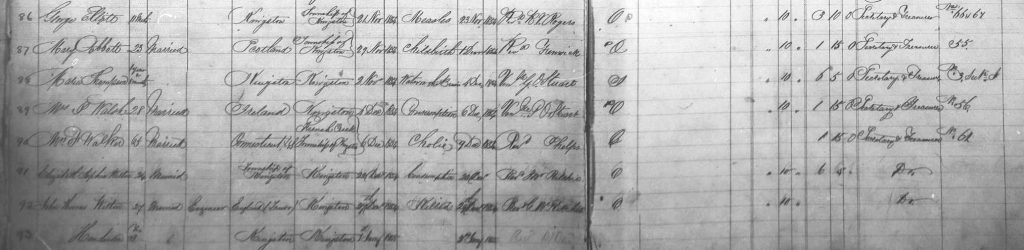
For difficult cases, we referred to the Branch’s transcription record. In cases where it was evident that the burial register entry contained errors, the information in the transcription record was used. A dash (-) for a particular field means no information was recorded or it was illegible.
(Note that many or most of the branch transcription records for Cataraqui Cemetery are from the 1990s and early 2000s. It is those that we used.)
Transcriptions were done by one volunteer and then reviewed by a second person, but errors may have slipped through. If you cannot find a name, try variations in spelling, search by first name only, or search for the first characters of the name. For errors, check with the cemetery office or suggest a correction by sending a message to the Branch Cemetery Committee.
Interment numbers were not always sequential; some were reused, while others were omitted. All surnames are written in CAPITAL letters. Military ranks and professional titles (e.g., Reverend, MD) are not included in the index, even when they were included in the burial register.
Where no surname was recorded, the surname is listed as “UKN.” Where no given names were recorded, the given names are indicated as “Ukn” (unknown); male or female was added if specified, i.e., “Ukn female,” or “Ukn male,” as appropriate. Where a child was buried but no given names were recorded, the name is shown as “Ukn infant.” This includes babies, stillborn babies, and other children where no name was provided.
For married women where given names were not recorded, and only “Mrs.” was used, they are shown as “Ukn female.” If the husband’s name was recorded, it is placed in brackets. For example, Mrs. Angus Smith was indexed as “SMITH, (Mrs. Angus).” Where only initials were provided and it was unclear whether they belonged to the woman or her husband, it was assumed the initials were those of the woman.
Location of Graves
A map of the cemetery can be found here or on the Cataraqui Cemetery website. The location of a grave is generally identified by its section and lot, though this is not always the case. In some instances, parts of the cemetery were assigned names historically, but were not associated with specific sections in the burial register.
For example, areas known as Potters Field (126 entries), Common Ground (1,051 entries), and Asylum Ground (257 entries) are all part of Section Old G, though the section designation is omitted from the register.
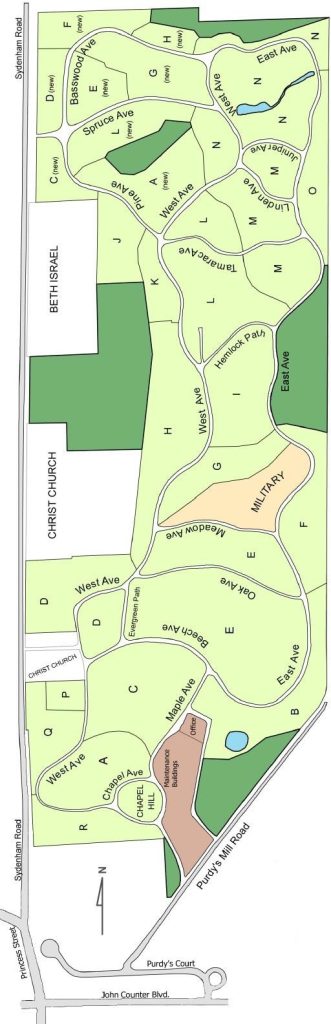

Potters Field and Common Ground refer to the same area, one that forms a substantial section of the cemetery, designated for those who could not afford a burial, those who passed away in hospitals or institutions, or whose remains were unclaimed. Despite there being numerous individuals interred in this section, very few grave markers are present.
There are also 1,428 entries for individuals who are listed as being buried “Elsewhere.” These entries refer to people who passed through Cataraqui Cemetery but whose final resting place is located somewhere else. Often, these were individuals who passed away during the winter months when the ground was frozen, necessitating the temporary storage of their remains in the cemetery vault until spring arrived and they could be buried. The cemetery office typically does not have information about the location of “Elsewhere.”
Most of the entries for those buried elsewhere were not assigned interment numbers. In such cases, the preceding interment number on the same page was used to facilitate finding the entry on a page, with an “X” appended to the number to indicate that it is not an actual interment number. For example, Interment number 3015 lists Mary A. RULE. The next entry is for Donald WAY, but no interment number was recorded for his entry, so the index shows 3015X; however, this “X” does not appear in the burial register.
In the 1950s, the cemetery introduced new sections named “New A,” “New C,” up to “New L,” excluding B, I, J, and K. The burial register did not differentiate between old and new sections, requiring a review of all post-1950 entries to check if they matched the cemetery transcription record for grave markers. If no match was found, most ambiguities were resolved with assistance from the cemetery office. Entries that could not be resolved are listed as
“A or New A,” “C or New C,” etc.
Links to related pages:
- Cataraqui Cemetery Records
- Using the Burial Register Index
- Cataraqui Cemetery Burial Register Index
- Cataraqui Cemetery Maps
- Cataraqui Cemetery and Funeral Services
- Using the Burial Register Index