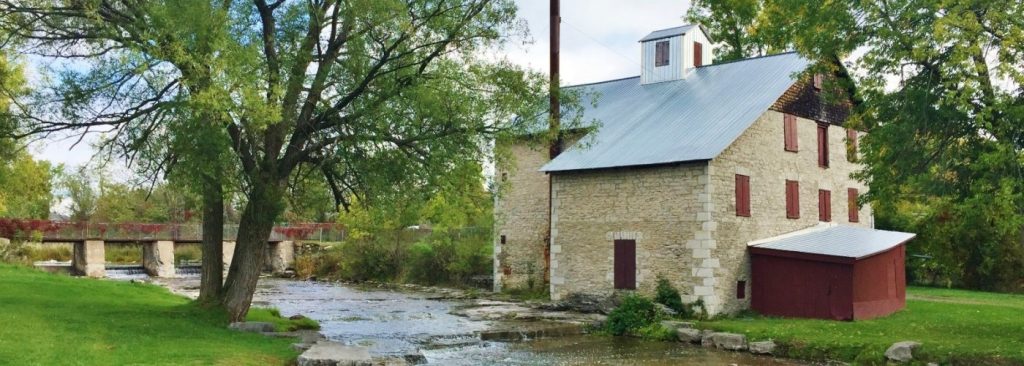
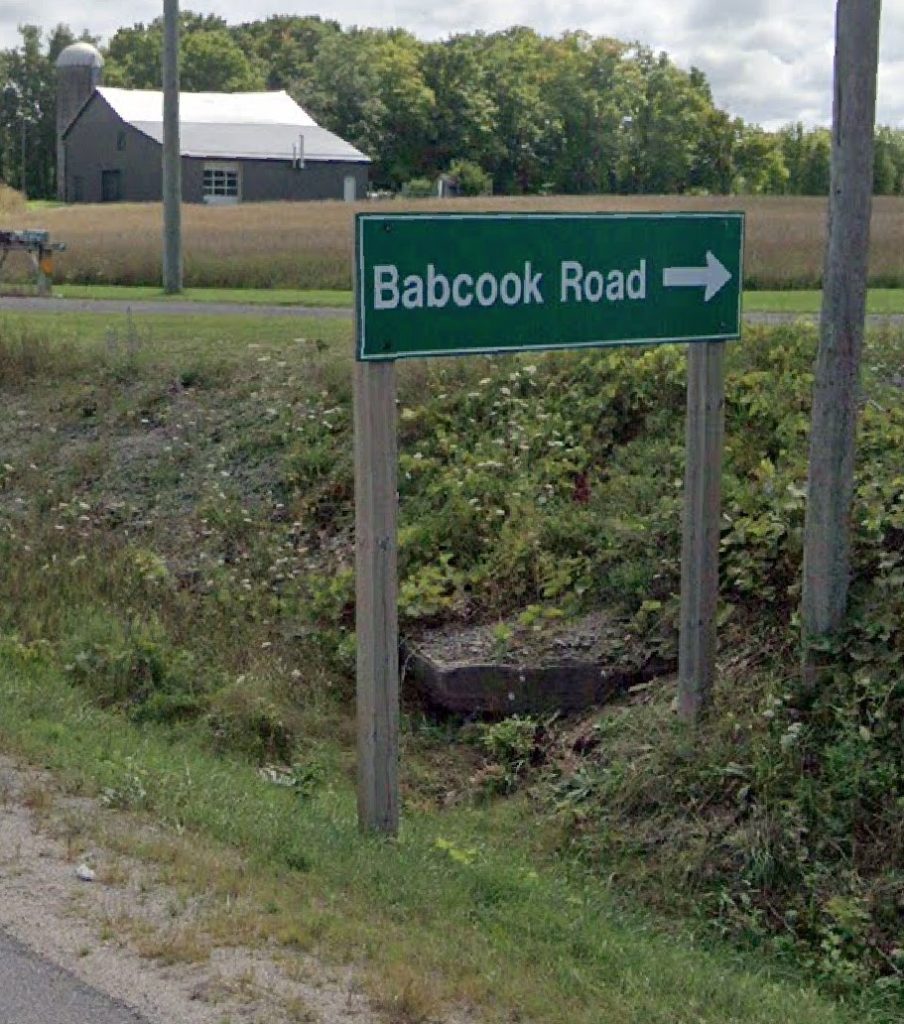
For over 200 years, Babcock families have lived in and around Kingston and the counties of Frontenac, Leeds & Grenville, Lennox & Addington, and Prince Edward. If you have roots in the region, even if you haven’t discovered Babcocks somewhere in your own family tree, you will encounter the name Babcock or Babcook on area signposts. There is a Babcook Road near Harrowsmith, and at least three Babcock roads and lanes in Central and South Frontenac. The Babcock Mill is a historic site in Odessa, popular for summer picnics and walking. There is even a Babcock Lake in the upper reaches of the Napanee river system.
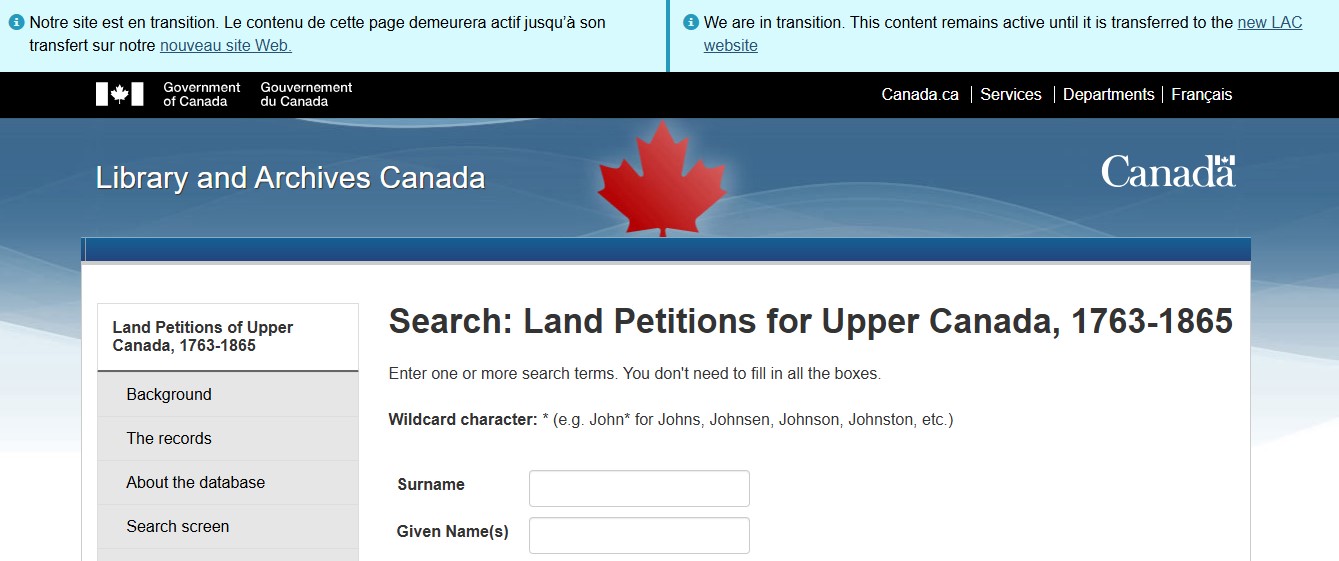
Most of the original Babcock settlers in Upper Canada were loyalist refugees from the American Revolutionary War. Some were United Empire Loyalists, some were soldiers in the regular British Army (and therefore loyal but not UELs), and many were loyalist sympathizers or relatives of the active participants in the hostilities. Most of them were granted land by the Crown. Consequently, their petitions and land records provide extensive documentation for many Babcocks, including (at least) two Davids1, three Benjamins2, and one John3.
These records tell us that before the war, most of these men had lived along or near the lower Hudson River in what are now New York and New Jersey – places with names like Haverstraw, Ramapough, and Bergen County. And the action of David and Benjamin Babcock in defending the Blockhouse at Bergen Wood during the war is well documented in the UELAC files4.
Having these records available is greatly appreciated by present-day genealogists, even if the duplication of names can be frustrating. Those of us descended from the Upper Canada Babcocks are usually thrilled to find such good documentation for our connections back as far as 1775. That is seven or eight generations, which is great! But if only we could uncover one or two more names, or confirm a place of birth, we’d have another generation! And then, … well, of course the quest is never completed.
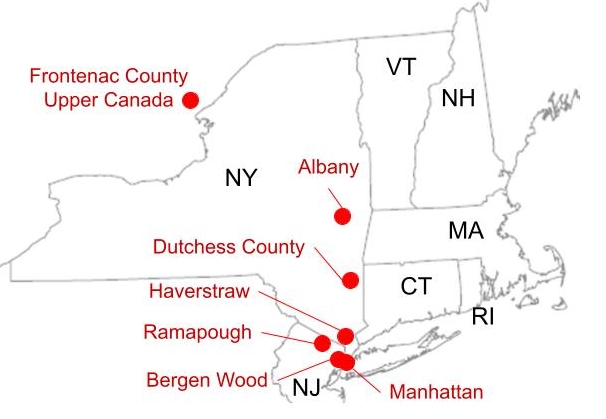
Tantalizingly, from where these loyalists had lived in New York and New Jersey, there were many Babcock families living a short distance to the east in Massachusetts and Rhode Island – a distance that could be travelled by horseback in a few days.
This being genealogy, we have evidence going back even further in time. Researchers are confident that three men migrated from England to America in the 1640s: brothers Robert and George Badcock arrived in Massachusetts and an unrelated James Badcock or Babcock arrived in Rhode Island at about the same time.
Researchers can make these inferences based on analysis of first, genealogical and second, genetic evidence. The genealogical analysis is exactly what all of us do in our spare time: looking through records and family histories to build out our family trees as far back as we can go. The genetic analysis focuses on Y-DNA data, which is passed from grandfather to father to son. Y-DNA mutates slowly and does not dilute in the way that Autosomal DNA (atDNA) does, so it is possible to draw inferences about family relationships and timing of most recent common ancestors between individuals for several generations farther back than is possible using only Autosomal DNA. However, while all family members can have their atDNA tested, only males have Y-DNA to contribute.
The magic happens when we look at genealogical and genetic evidence together: genetic results can support or call into question pedigree claims and can trigger searches for records in alternative regions. Looking at family trees produced through genealogical research can suggest candidates to take DNA tests, with the hope that the new data might confirm or disprove a presumed relationship.
By examining the Y-DNA of living Babcock males in England, the United States, and Canada, we have come to understand the following:
- Evidence suggests that two unrelated males whose descendants became Babcocks or Badcocks migrated from Europe to England, probably sometime between 545 BCE and 769 CE. The DNA of one was in the I Haplogroup and the other’s in the E Haplogroup.

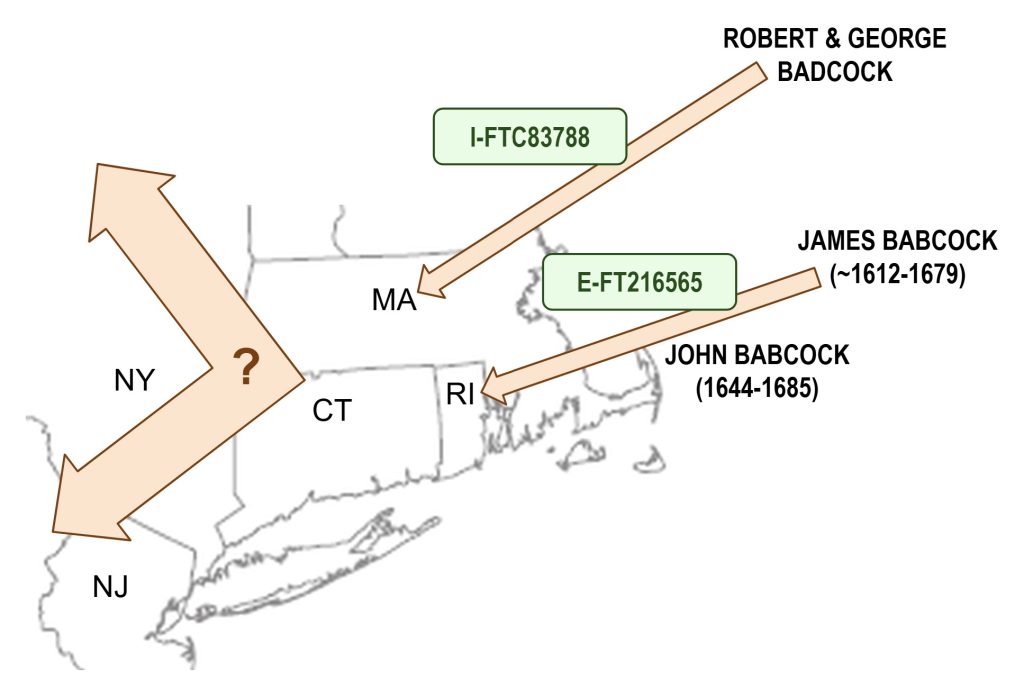
- Brothers Robert and George Badcock, who settled in the Massachusetts Bay colony in the 1640s, had Y-DNA in the I Haplogroup.
- James Badcock (1612-1679) (whose family soon adopted the name Babcock) settled in the Rhode Island colony around the same time. His Y-DNA was in the E-Haplogroup.
- Generations later, descendants of these families moved west, with some settling in southern New York and northern New Jersey, and others migrating further afield.
Genealogists have constructed the family tree and descendants of John Babcock (1644-1685), one of the sons of the Rhode Island settler, James Badcock (1612-1679). Results from Y-DNA tests taken by several of John’s known descendants through his sons James (1664-1737), John (1669-1746), and Oliver (1683-1773) have been found to match and have been assigned to Clade E-FT216565, within the E Haplogroup.
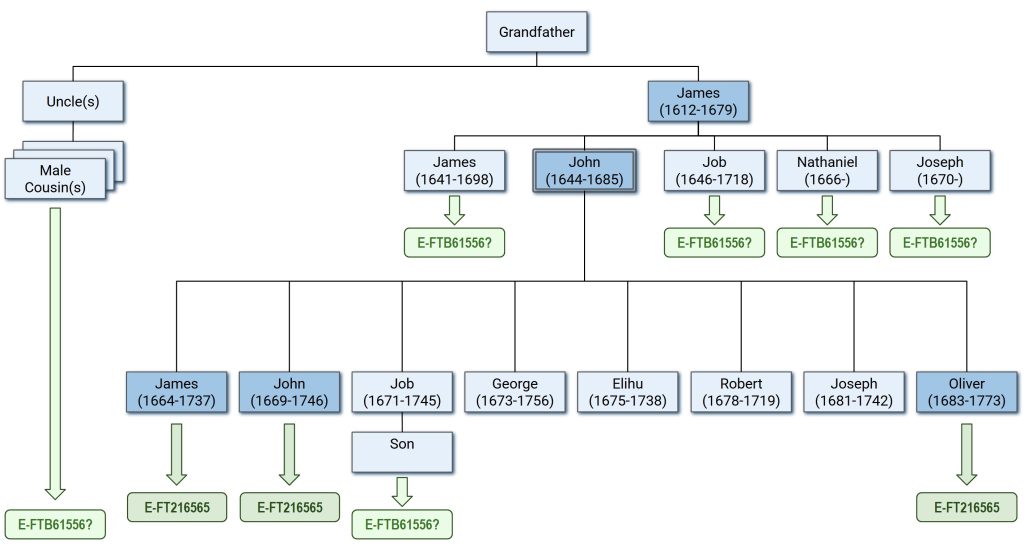
Graphics by Kent Babcock and Alan Boyce
However, the Y-DNA of many Babcock testers appears in the E-FTB61556 Clade and four of the six testers are Canadian Babcocks; it is not clear where in the family this branch in the DNA occurred. However, we are confident that it was not in the descendants of James Jr., John, or Oliver. We’d like to know where it did arise because it might support one or another interpretation of the genealogical record.
We also don’t have any genealogical information about the descendants of the other sons (George, Elihu, Robert, and Joseph) of John Babcock (1644-1685), or about John’s uncles or cousins. It would similarly be useful to have this information.
In addition, Y-DNA results of some testers fall into a different clade: E-FTD42252; where do they fit into the tree? And, of course, we still encounter testers whose results are in the I Haplogroup; it would be good to have a better understanding of the history of those families as well.
I am confident that my fourth great-grandfather was named Benjamin Babcock, that he was a proven United Empire Loyalist, and that his daughter, Sarah, married Isaac Smith, the brother of Darius Champion Smith. It appears that Benjamin’s father was named Job Babcock, and that he was the great-grandson of John Babcock (1644-1685), but it would be good to have DNA evidence to support that.
As for the other Babcocks around Kingston, Upper Canada? Benjamin and Captain David Babcock, famous for their Revolutionary War defense of the Block House in Bergen Wood4, settled here – were they (as is believed) cousins or brothers?
And Ensign John Babcock, who is accepted as having been “from Haverstraw,” but there is some confusion over his place of birth: New Jersey or England? He settled in what is now Prince Edward County, Ontario. It could be very revealing if any descendants of these men were tested and if they had some documentation of their family history.
So, if you’d like to help out with this study, we’d be delighted to hear from you.
- If you are a Babcock man, then your Y-DNA test results could be very helpful.
- If you have Babcock family tree records, then you might be able to fill in some of the blanks in the Babcock tree.
- If you’d just like to help out, there is always research and analysis to be done.
To participate or to receive more information, please email Kent Babcock or the Kingston Branch OGS Webmaster directly. One of us will be sure to get back to you.
This is Citizen Science and you can be part of it!
Notes:
Thanks to Kent Babcock for doing the historical and genealogical research and the genetic analysis on which this article is based.
- David Babcock U.E. (1752-1818), David Babcock (1756-1812) ↩︎
- Benjamin Babcock U.E. (1754-1829), Benjamin Babcock U.E. (1762-1843), Benjamin Babcock (1740-1779) ↩︎
- John Babcock U.E. (1747-1817) ↩︎
- Dr. H. H. Burleigh, Genealogist of the Bay of Quinte Branch UELAC. The Block House in Bergen Wood. Address given to the Bay of Quinte UELAC Branch at Napanee on 3 March 1965. Accessible from UELAC or here. Paid membership required. ↩︎
- To view the FamilyTreeDNA projects, paid membership with FamilyTreeDNA.com is required. ↩︎
- To view certain resources on the OGS Kingston Branch website, paid membership with Kingston Branch OGS is required. ↩︎
More background is also available by following these links:
- The WikiTree Y-DNA Babcock-Badcock Project
- The FamilyTreeDNA Babcock-Badcock Project 5
- The FamilyTreeDNA Babcock-Badcock Project Activity Feed
- Kingston Branch OGS Newsletter, March-April 2025 6
Members of the Kingston Branch OGS may be able to provide some help to get you started building your family tree. Contact the Branch Research Coordinator for more information.