Adapted (with permission) from UELAC Kingston Bulletin: The Cataraqui Town Crier, 2025 November.
See notes below.
The Royal Proclamation of 1763 had forbidden settlement in Canada, west of the Ottawa River, roughly speaking. This was reserved as Indigenous Territory. Provision was made, however, for future land negotiations between the Crown and the Indigenous peoples. Furthermore, anybody who had settled on the lands in question was ordered out “forthwith”. Thus, the first permanent authorized settlement west of the Ottawa River was sanctioned when Governor Haldimand received, in Quebec City, the following proclamation from King George III on 12 June 1784.
“His Majesty approves the plan you have proposed for settling some of the Loyalists at Cataraqui and places adjacent” (Haldimand Papers Reel 20 Page 92 – Queen’s Archives). Governor Haldimand had every reason to believe that this approval would be forthcoming. The party under Michael Grass, and others, had already departed Sorel for “Cataraqui and places adjacent.” Kingston celebrates June 12 as Loyalist Day each year to commemorate approval as the first permanent authorized settlement west of the Ottawa River.
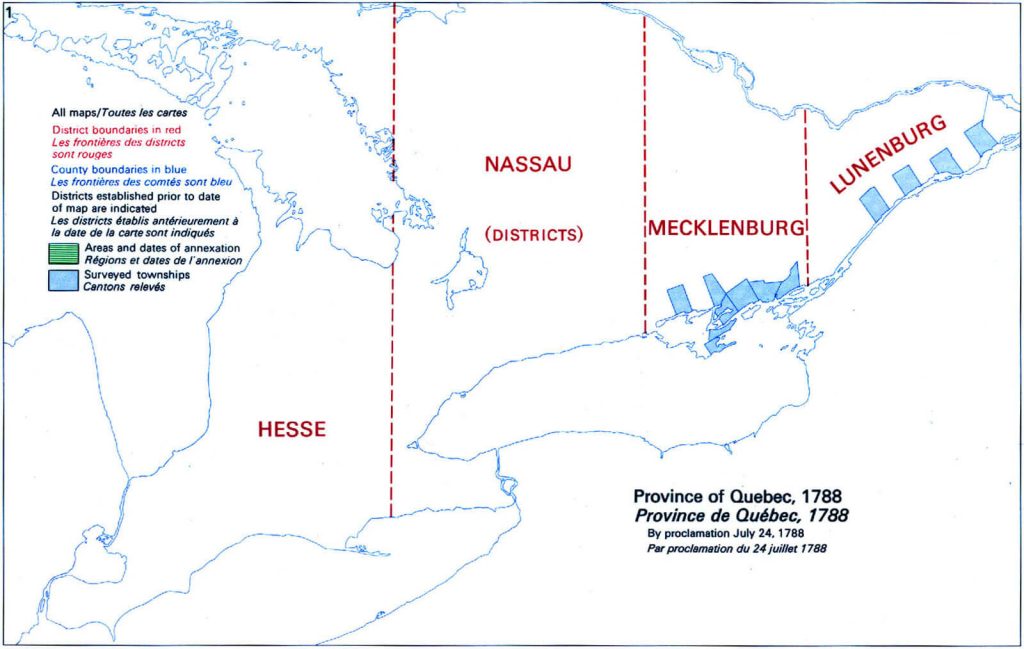
The territory of the Province of Quebec at this time extended all the way to the present Windsor area. The Loyalists were not pleased with the French (Quebec) system of land-holding and other governmental laws and practices emanating from the seat of government in Quebec City. This prompted the British government to pass the Constitutional Act in 1791. This Act split the territory into two parts:
- Lower Canada (what is the Province of Quebec today), which continued to use the systems of land-holding and other laws in place, and
- Upper Canada (now Ontario), whose inhabitants were granted the British system of landholding.
Each of the new provinces was given authority to enact laws for “Peace, Welfare and good Government,” which Upper Canada took advantage of in 1792 to establish English common law for private law matters in the province.
Royal assent was given to the Act on 19 June 1791. (On 18 December 1997, the Ontario Legislature approved a bill making June 19 United Empire Loyalist Day in the Province of Ontario.)
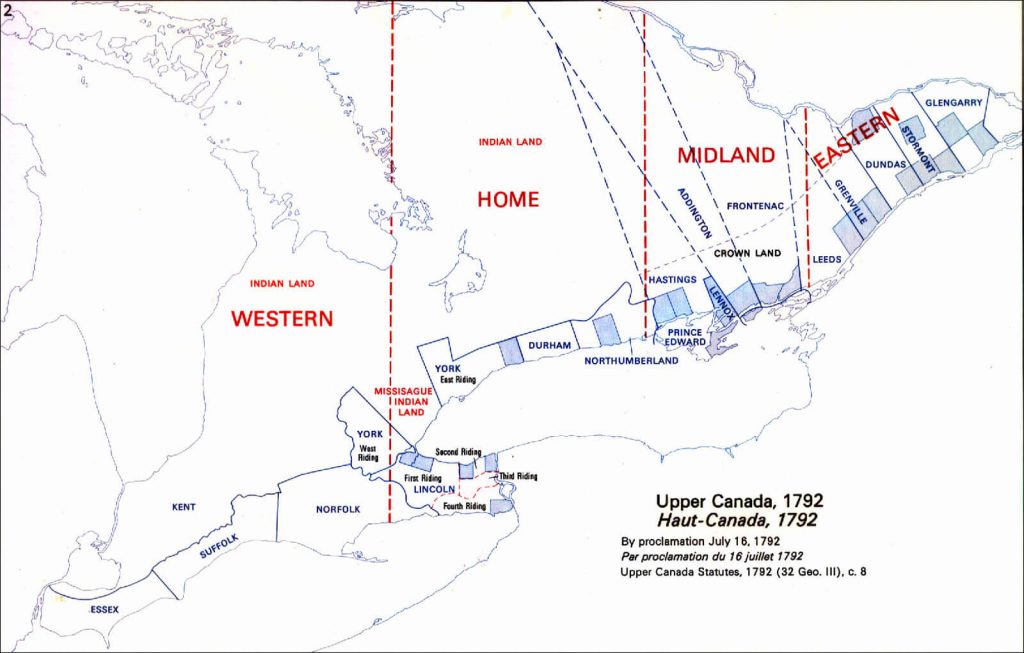
It is a matter of interest, however, that the Constitutional Act was not put into effect until 26 December 1791. On that day, Lower Canada (the current province of Quebec) began operations under Lieutenant-Governor Alured Clarke. The Lieutenant-Governor designate of Upper Canada, John Graves Simcoe, however, did not arrive in Quebec City from Great Britain until November 1791. He spent the next seven or eight months in Quebec City preparing for his assignment in Upper Canada. On 7 February 1792, he issued his call for new settlers to come from the United States to Upper Canada. However, he could only legally be sworn into his new office before a quorum of his provincial Executive Council. When William Osgoode, his Chief Justice, and Peter Russell, his Receiver General, arrived in Canada in June 1792, Simcoe at last set out for Upper Canada, landing in Kingston. On July 8, he took his oath of office in St. George’s Church and Upper Canada was legally constituted.
Notes:
Changes from the original article include
- Corrections to the name of the 1791 act. It was the “Constitutional Act, 1791.”
- (In 1867, the act of British Parliament creating the Dominion of Canada was called the “British North America Act, 1867;”
- upon patriation of the Constitution to Canada in 1982, the “British North America Act, 1867” was renamed to the “Constitution Act, 1867.”)
- Clarified the legal changes actually made by the Constitutional Act.
- Some changes for style.
- Addition of maps of the region covering the period being discussed.
- Addition of links to the 1791 act and other history, from the website of the Lieutenant Governor of Ontario. See pages on History / Pre-Confederation / Lieutenant Governors of Upper Canada (1791–1841).
- The Constitutional Act, 1791.
- The Act of Union, 1840 (which, among other things, created Canada West and Canada East out of Upper and Lower Canada).
This article is adapted (with permission) from an article printed in the Volume 44, No. 4, November 2025 issue of “The Town Crier,” the publication of the Kingston Branch of the United Empire Loyalists Association of Canada (UELAC). The complete issue is available to UELAC members here.
Information on joining the UELAC is available here.
The Kingston and District Branch newsletter is published in the first week of February, April, September, and November. If you have an interesting story or article that you would like considered for inclusion in their newsletter, please forward it to Richard G. Parry UE, Newsletter editor, at [email protected].
The Kingston and District Branch of the UELAC meets four times per year, on the fourth Saturday in September, November, February, and April. More information on UELAC can be found by clicking this link.